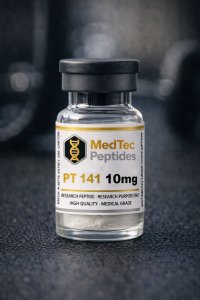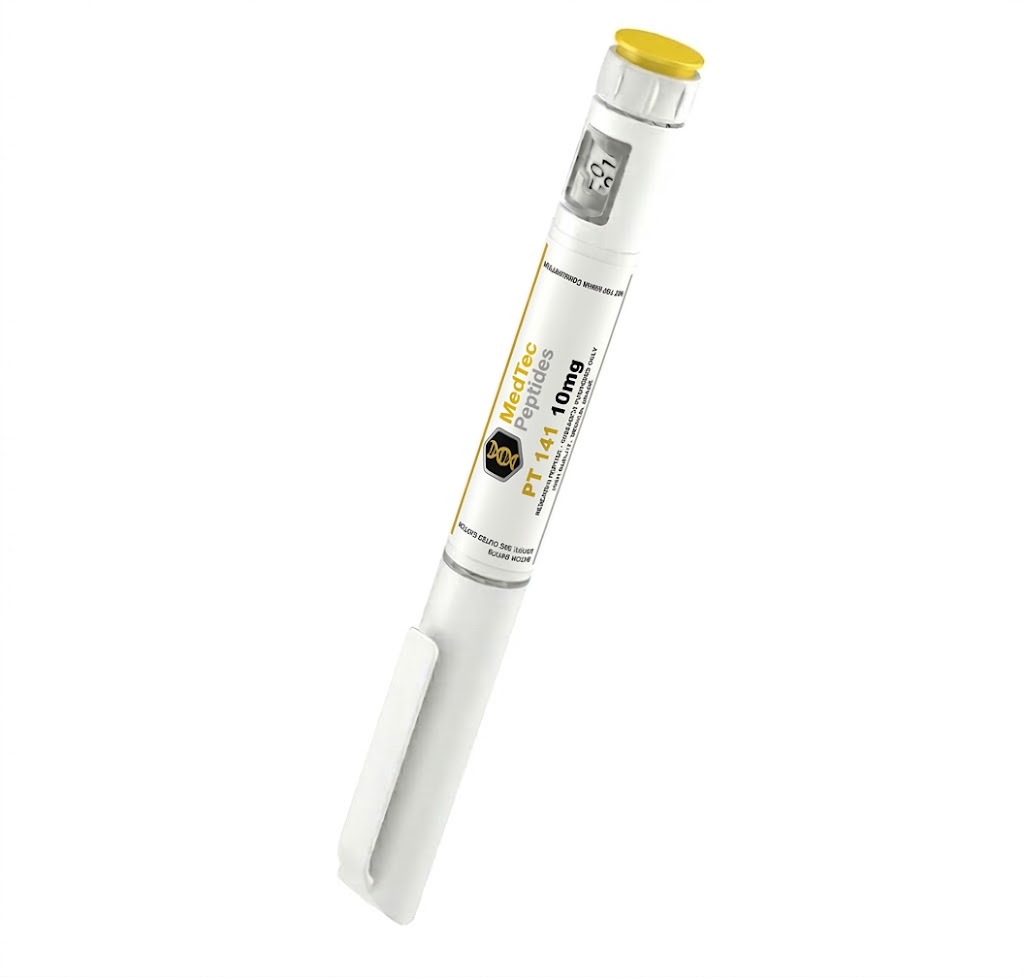

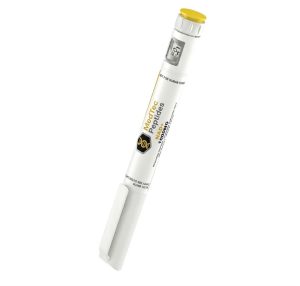
PT 141 10 mg
- Estimated Delivery : Up to 4 business days
- Free Shipping: On all orders over £150
Research Use Only
These products are for laboratory research only and not intended for medical use. They are not FDA-approved to diagnose, treat, cure, or prevent any disease. By purchasing, you certify they will be used solely for research and not for human or animal consumption.
Description:
PT-141 is a synthetic peptide designed to enhance libido and participate in treating various forms of sexual dysfunctions. It is also known as Bremelanotide, and the origin of the name is explained by the fact that its primary mechanism of action involves the activation of Melanocortin receptors. The results of scientific studies indicate that PT-141 achieves equally good results in treating sexual dysfunctions in both sexes, some of the most common being erectile dysfunction in men and hypoactive sexual desire in women. Additionally to achieving long-lasting effects fairly quickly from the start of administration, this peptide can improve sexual satisfaction, boost self-confidence, and reduce symptoms of anxiety related to sexual intercourse.
PT-141 – Bremelanotide is a synthetic peptide primarily used to treat sexual dysfunction in men and women. Unlike other similar compounds, the mechanism of action of this peptide is not based on the modulation of vascular permeability but instead on direct stimulation of the part of the central nervous system responsible for sexual desire and reaction to sexual stimuli.
Scientists assume that this peptide primarily binds to Melanocortin receptors (especially MC4R), further activating them. After binding, many substances are released in large amounts, which is responsible for increasing sexual desire, such as Domanin. These substances are typically produced during sexual intercourse and lead to ejaculation in men, so the system of treating dysfunction is mainly based on potentiating vital release.
One of the primary sexual drive disorders in men is erectile dysfunction. It is characterized by difficulty achieving an erection, as well as the inability to maintain it for a long time. This is a relatively common diagnosis, and causes vary. They can be psychogenic or somatic when it often appears as a symptom of severe diseases. PDE5 inhibitors (inhibit the enzyme phosphodiesterase type 5) are frequently the first-choice therapy for such patients. However, patients usually do not respond to this treatment. As it works by regulating blood flow through the blood vessels, patients with cardiovascular diseases or diabetes mellitus can’t use the drug. That is why PT-141 has proven to be particularly potent, as it acts directly on the central nervous system. The results have been confirmed in practical terms through clinical studies when most patients reported improvement in symptoms, regular achievement of erections, and maintenance. In addition to these effects, men felt more confident during intercourse, with a complete absence of fear.
When it comes to women, hypoactive sexual desire is the most common sexual desire disorder. It is characterized by the absence of spontaneous sexual thoughts, a lack of desire for intimate relationships, and the inability to enjoy them. The reasons vary and can be psychological, somatic, or the result of long-term therapy. However, this kind of problem can cause issues in the relationship, mainly when it occurs in young women. It was found that with a similar mechanism of action, PT-141 can cause significant improvement by increasing sexual desire and enabling the enjoyment of intercourse. Patients reported an easier onset and normal course of the intimate act after therapy.
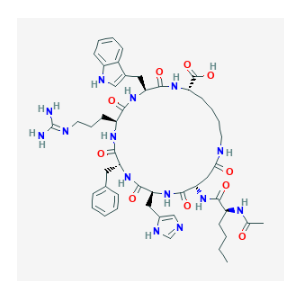
Molecular Structure of PT-141
Chemical composition and properties
Sequence: Ac-Nle-Asp(1)-His-D-Phe-Arg-Trp-Lys(1)
Molecular Formula: C50H68N14O10
Molecular Weight: 1025.182 g/mol
PubChem CID: 9941379
CAS Number: 189691-06-3
References:
- Molinoff, P. B., Shadiack, A. M., Earle, D., Diamond, L. E., & Quon, C. Y. (2003). PT-141: a melanocortin agonist for the treatment of sexual dysfunction. Annals of the New York Academy of Sciences, 994, 96–102. https://doi.org/10.1111/j.1749-6632.2003.tb03167.x
- Pfaus, J., Giuliano, F., & Gelez, H. (2007). Bremelanotide: an overview of preclinical CNS effects on female sexual function. The journal of sexual medicine, 4 Suppl 4, 269–279. https://doi.org/10.1111/j.1743-6109.2007.00610.x
- Vemulapalli, R., Kurowski, S., Salisbury, B., Parker, E., & Davis, H. (2001). Activation of central melanocortin receptors by MT-II increases cavernosal pressure in rabbits by the neuronal release of NO. British journal of pharmacology, 134(8), 1705–1710. https://doi.org/10.1038/sj.bjp.0704437
- Thurston, L., Hunjan, T., Mills, E. G., Wall, M. B., Ertl, N., Phylactou, M., Muzi, B., Patel, B., Alexander, E. C., Suladze, S., Modi, M., Eng, P. C., Bassett, P. A., Abbara, A., Goldmeier, D., Comninos, A. N., & Dhillo, W. S. (2022). Melanocortin 4 receptor agonism enhances sexual brain processing in women with hypoactive sexual desire disorder. The Journal of clinical investigation, 132(19), e152341. https://doi.org/10.1172/JCI152341
- Clayton AH, Althof SE, Kingsberg S, DeRogatis LR, Kroll R, Goldstein I, Kaminetsky J, Spana C, Lucas J, Jordan R, Portman DJ. Bremelanotide for female sexual dysfunctions in premenopausal women: a randomized, placebo-controlled dose-finding trial. Womens Health (Lond). 2016 Jun;12(3):325-37. doi: 10.2217/whe-2016-0018. Epub 2016 May 16. PMID: 27181790; PMCID: PMC5384512.
- James Pfaus, François Giuliano, Hélène Gelez, Bremelanotide: An Overview of Preclinical CNS Effects on Female Sexual Function, The Journal of Sexual Medicine, Volume 4, Issue Supplement_4, November 2007, Pages 269–279, https://doi.org/10.1111/j.1743-6109.2007.00610.x
- McMillan TR, Forster MAM, Short LI, Rudecki AP, Cline DL, Gray SL. Melanotan II, a melanocortin agonist, partially rescues the impaired thermogenic capacity of pituitary adenylate cyclase-activating polypeptide deficient mice. Exp Physiol. 2021 Feb;106(2):427-437. doi: 10.1113/EP088838. Epub 2020 Dec 17. PMID: 33332767.
| Peptide Option | 3ml Pen Option, 3ml Vial Option |
|---|
Related products
-

Retatrutide 20mg
Price range: £109 through £179 -

BPC 157 10mg
Price range: £39 through £69 -


BPC-157 & TB-500 blend 10mg/10mg
Price range: £55 through £89 -

Epithalon 10mg
Price range: £25 through £79 -

Nad+ 1000mg
Price range: £99 through £135 -

Bacteriostatic Water 3ml
£4.50