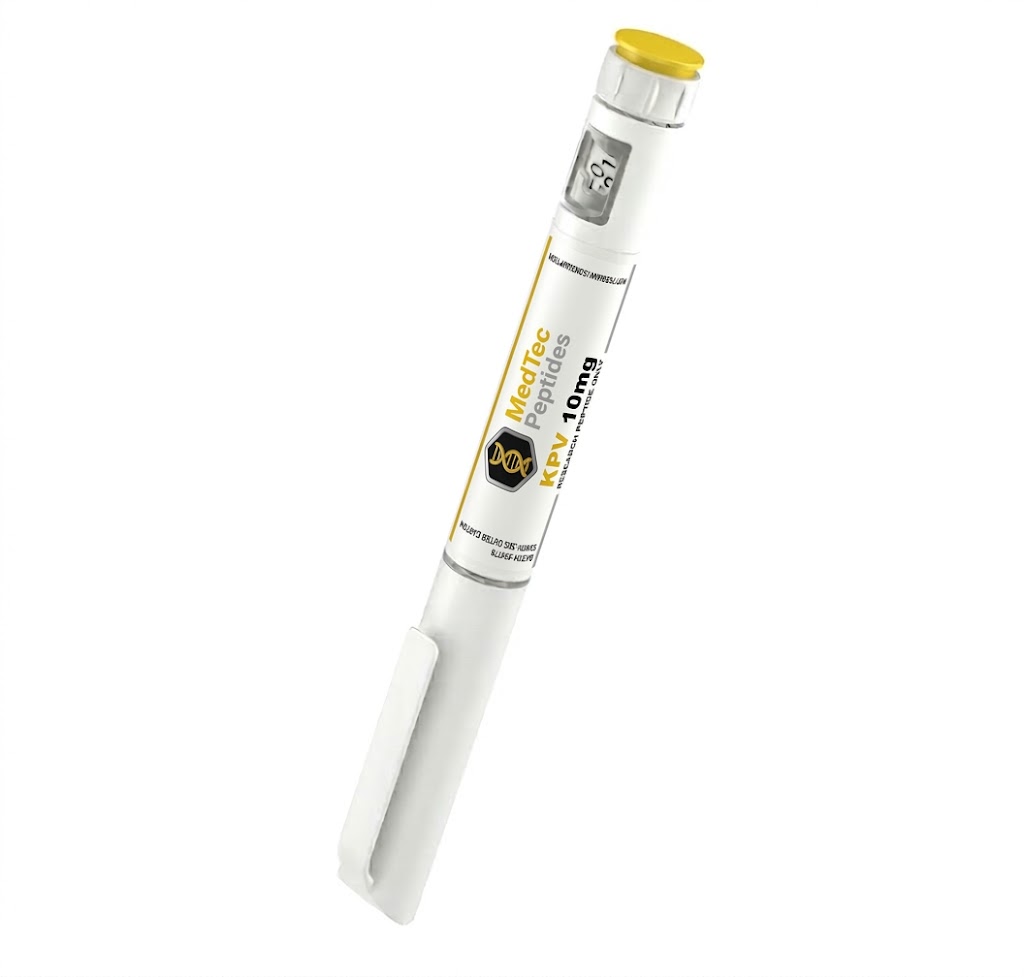

KPV 10mg
- Estimated Delivery : Up to 4 business days
- Free Shipping: On all orders over £150
Research Use Only
These products are for laboratory research only and not intended for medical use. They are not FDA-approved to diagnose, treat, cure, or prevent any disease. By purchasing, you certify they will be used solely for research and not for human or animal consumption.
Description:
KPV is a tripeptide (lysine – proline – valine) obtained from the alpha-melanocyte stimulating hormone (Alpha-MSH). This natural neuroregulatory peptide is known for its anti-inflammatory and antimicrobial properties. In different forms of the application, it can be useful for treating various states based on inflammation. If used in topical cream form, it can potentially prevent further development of eczema, psoriasis and acne. The oral application could be significant in treating inflammatory diseases of hoses such as ulcerative colitis, Crohn’s disease and inflammatory intestine syndrome. Injection use manifests overall anti-inflammatory effects. According to various studies, KPV could potentially accelerate wound healing and reduce the possibility of scarring after surgery. This peptide expresses all the mentioned effects modified and significantly improved in relation to the original molecule.
Alfa-Melanocyte Stimulative hormone is the original natural molecule, with KPV as the derivative. Its crucial function is anti-inflammatory potential, achieved in several different ways. One of them is through melanocortine receptors (MC-R), localized on different central and peripheral nervous system cells.
Even if this property can be used in treating various diseases, Alfa MSH has been avoided for increasing melanin secretion, potentially causing skin cancer. However, KPV is the least active form in melanin production, reducing this risk significantly. Modifying chemical construction improves anti-inflammatory and other positive effects, but also reduces unwanted actions. The anti-inflammatory effect could be used in treating some skin conditions such as psoriasis, acne, and eczema. Many scientific studies assume that KPV can reduce the cytokines expression, and the activity of many inflammatory cells, reducing hypercheralatosis. In addition, angiogenesis (the process of creating new blood vessels) maintains the inflammation active and emphasizes it. Prevention of further angiogenesis is another mechanism of action.
The main property may be helpful in treating digestive problems (inflammatory bowel diseases such as Crohn’s disease, ulcerative colitis, and others). Based on a similar mechanism of action (reducing the production of TNF alpha and pro-inflammatory cytokines), KPV can accelerate the healing of wounds, localized on mucosa, restore epithelial cells, and thus alleviate symptoms such as diarrhea and severe pain.
In addition to the above properties, the peptide has the ability to modulate the immune response, accelerating regeneration mechanisms. Therefore, wounds after surgery heal faster without scarring. The peptide could also achieve antimicrobial activity and improve antifungal response, reducing the risk of wound infection. This property is also achieved by enhancing collagen synthesis, which results in rapid recovery.
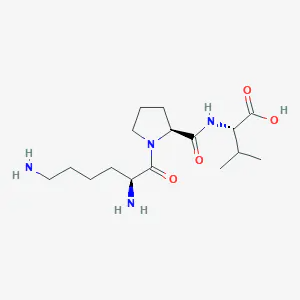
Structure
Molecular composition and structural details of KPV
Sequence: Lys-Pro-Val
Molecular Formula: C16H30N4O4
Molecular Weight: 342.43 g mol−1
PubChem CID: 125672
CAS Number: 67727-97-3
References:
- Dalmasso G, Charrier-Hisamuddin L, Nguyen HT, Yan Y, Sitaraman S, Merlin D. PepT1-mediated tripeptide KPV uptake reduces intestinal inflammation. Gastroenterology. 2008 Jan;134(1):166-78. https://pubmed.ncbi.nlm.nih.gov/18061177/
- Dalmasso, G., Charrier-Hisamuddin, L., Nguyen, H. T., Yan, Y., Sitaraman, S., & Merlin, D. (2008). PepT1-mediated tripeptide KPV uptake reduces intestinal inflammation. Gastroenterology, 134(1), 166–178. https://doi.org/10.1053/j.gastro.2007.10.026
- Kannengiesser K, Maaser C, Heidemann J, Luegering A, Ross M, Brzoska T, Bohm M, Luger TA, Domschke W, Kucharzik T. Melanocortin-derived tripeptide KPV has anti-inflammatory potential in murine models of inflammatory bowel disease. Inflamm Bowel Dis. 2008 Mar;14(3):324-31. doi: 10.1002/ibd.20334. PMID: 18092346.
- Bonfiglio V, Camillieri G, Avitabile T, Leggio GM, Drago F. Effects of the COOH-terminal tripeptide alpha-MSH(11-13) on corneal epithelial wound healing: role of nitric oxide. Exp Eye Res. 2006 Dec;83(6):1366-72. doi: 10.1016/j.exer.2006.07.014. Epub 2006 Sep 11. PMID: 16965771.
- de Souza KS, Cantaruti TA, Azevedo GM Jr, Galdino DA, Rodrigues CM, Costa RA, Vaz NM, Carvalho CR. Improved cutaneous wound healing after intraperitoneal injection of alpha-melanocyte-stimulating hormone. Exp Dermatol. 2015 Mar;24(3):198-203. doi: 10.1111/exd.12609. Epub 2015 Jan 12. PMID: 25431356.
- Cutuli M, Cristiani S, Lipton JM, Catania A. Antimicrobial effects of alpha-MSH peptides. J Leukoc Biol. 2000 Feb;67(2):233-9. doi: 10.1002/jlb.67.2.233. PMID: 10670585.
- Brzoska T, Luger TA, Maaser C, Abels C, Böhm M. Alpha-melanocyte-stimulating hormone and related tripeptides: biochemistry, antiinflammatory and protective effects in vitro and in vivo, and future perspectives for the treatment of immune-mediated inflammatory diseases. Endocr Rev. 2008 Aug;29(5):581-602. doi: 10.1210/er.2007-0027. Epub 2008 Jul 8. PMID: 18612139.
- Xiao B, Xu Z, Viennois E, Zhang Y, Zhang Z, Zhang M, Han MK, Kang Y, Merlin D. Orally Targeted Delivery of Tripeptide KPV via Hyaluronic Acid-Functionalized Nanoparticles Efficiently Alleviates Ulcerative Colitis. Mol Ther. 2017 Jul 5;25(7):1628-1640. doi: 10.1016/j.ymthe.2016.11.020. Epub 2017 Jan 28. PMID: 28143741; PMCID: PMC5498804.
| Peptide Option | 3ml Pen Option, 3ml Vial Option |
|---|
Related products
-

BPC 157 10mg
Price range: £39 through £69 -
Ipamorelin 10mg
Price range: £45 through £79 -

Retatrutide 20mg
Price range: £109 through £179 -

CJC with DAC 5mg
Price range: £45 through £79 -

AOD 9604
Price range: £39 through £79 -

SS-31 10mg
Price range: £45 through £79